Multi-element Transducers
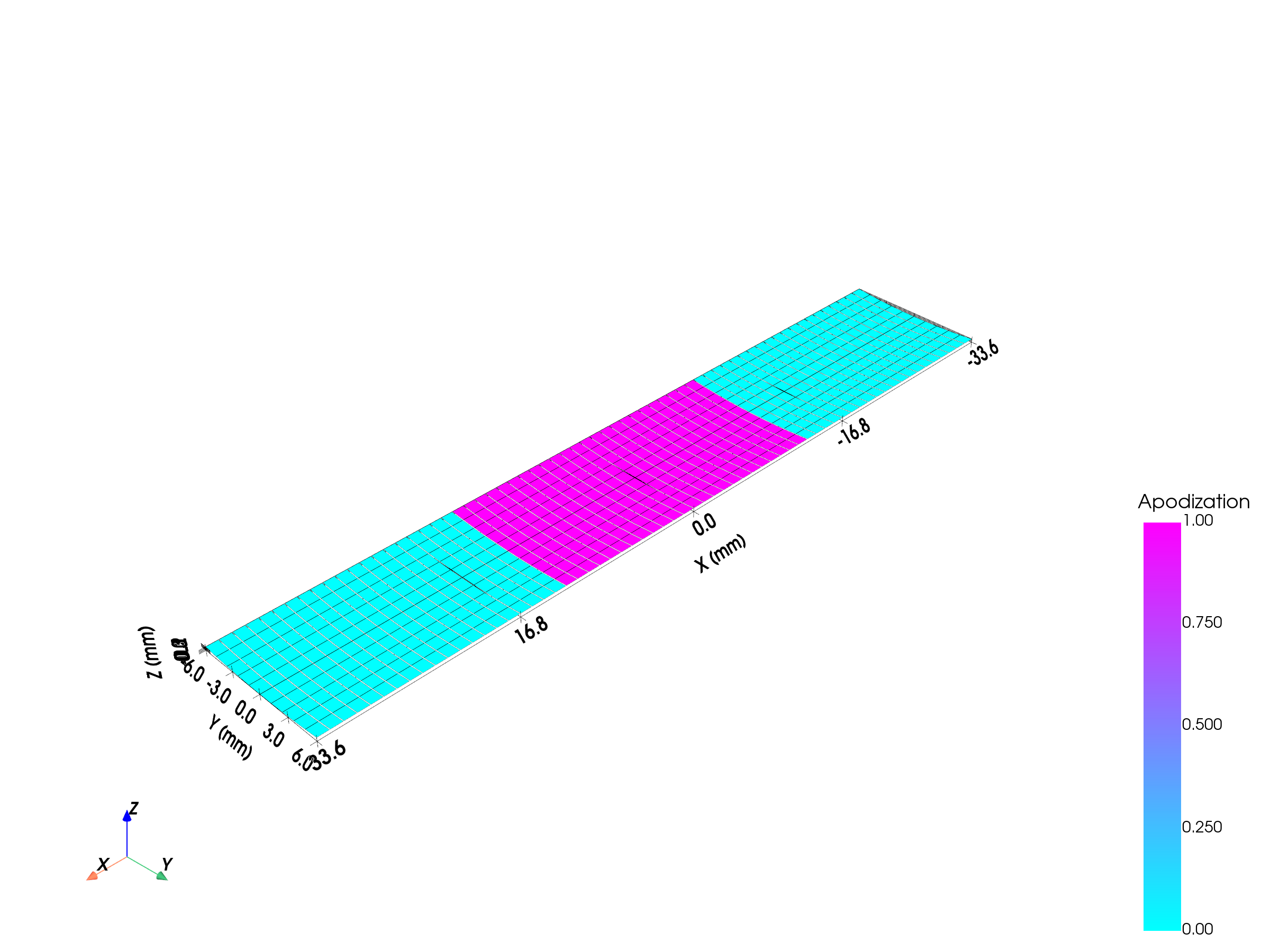
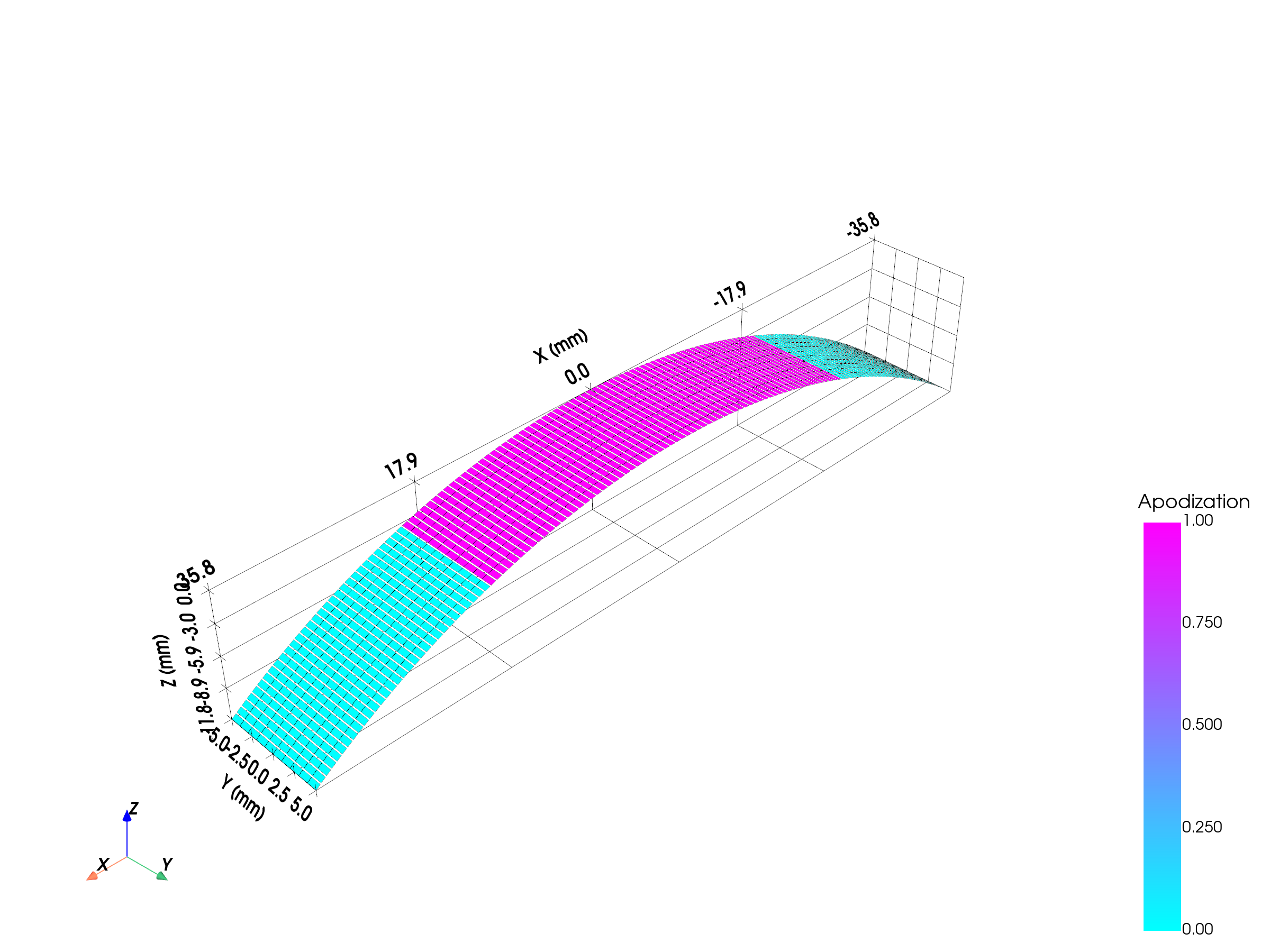
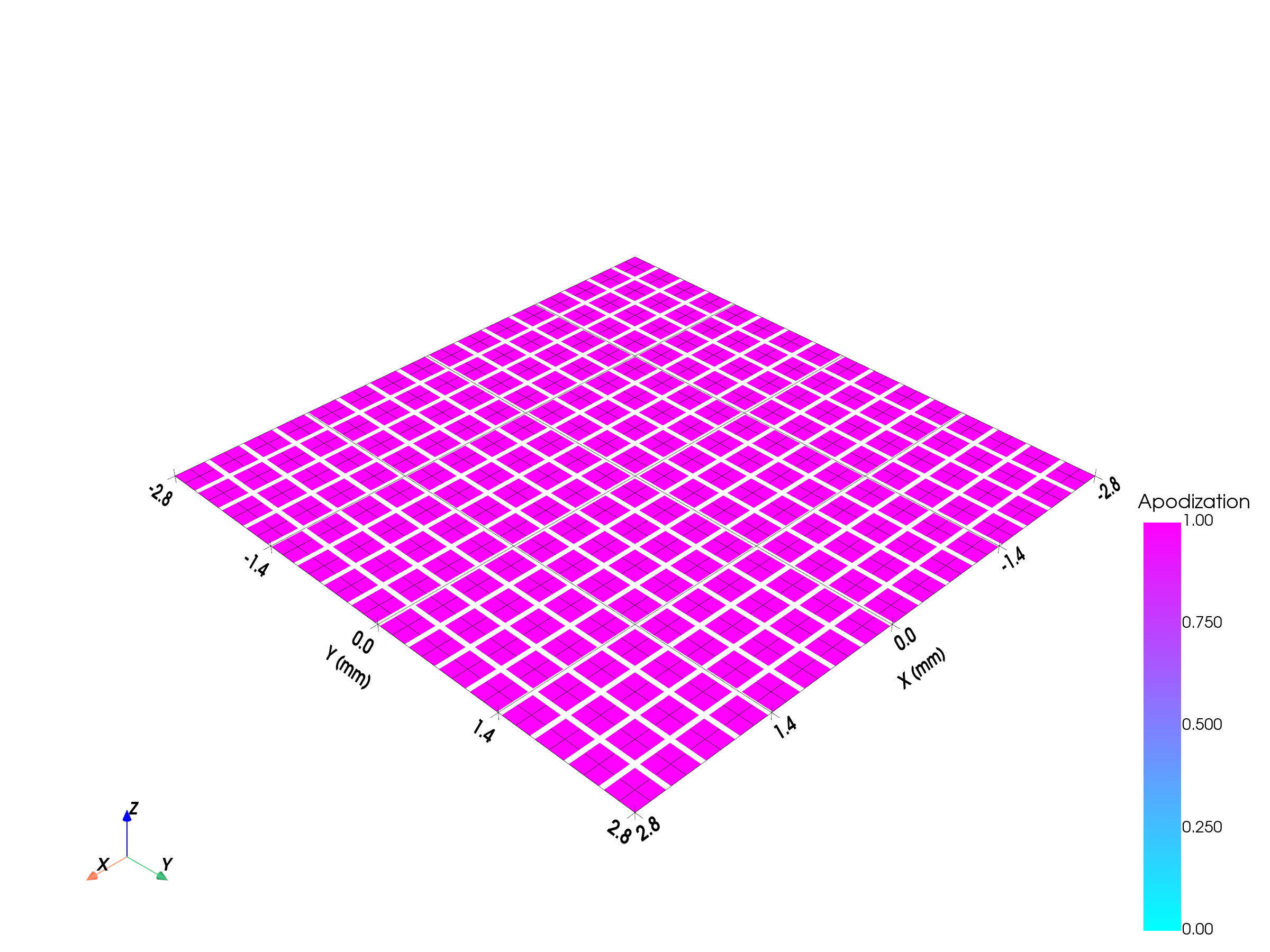
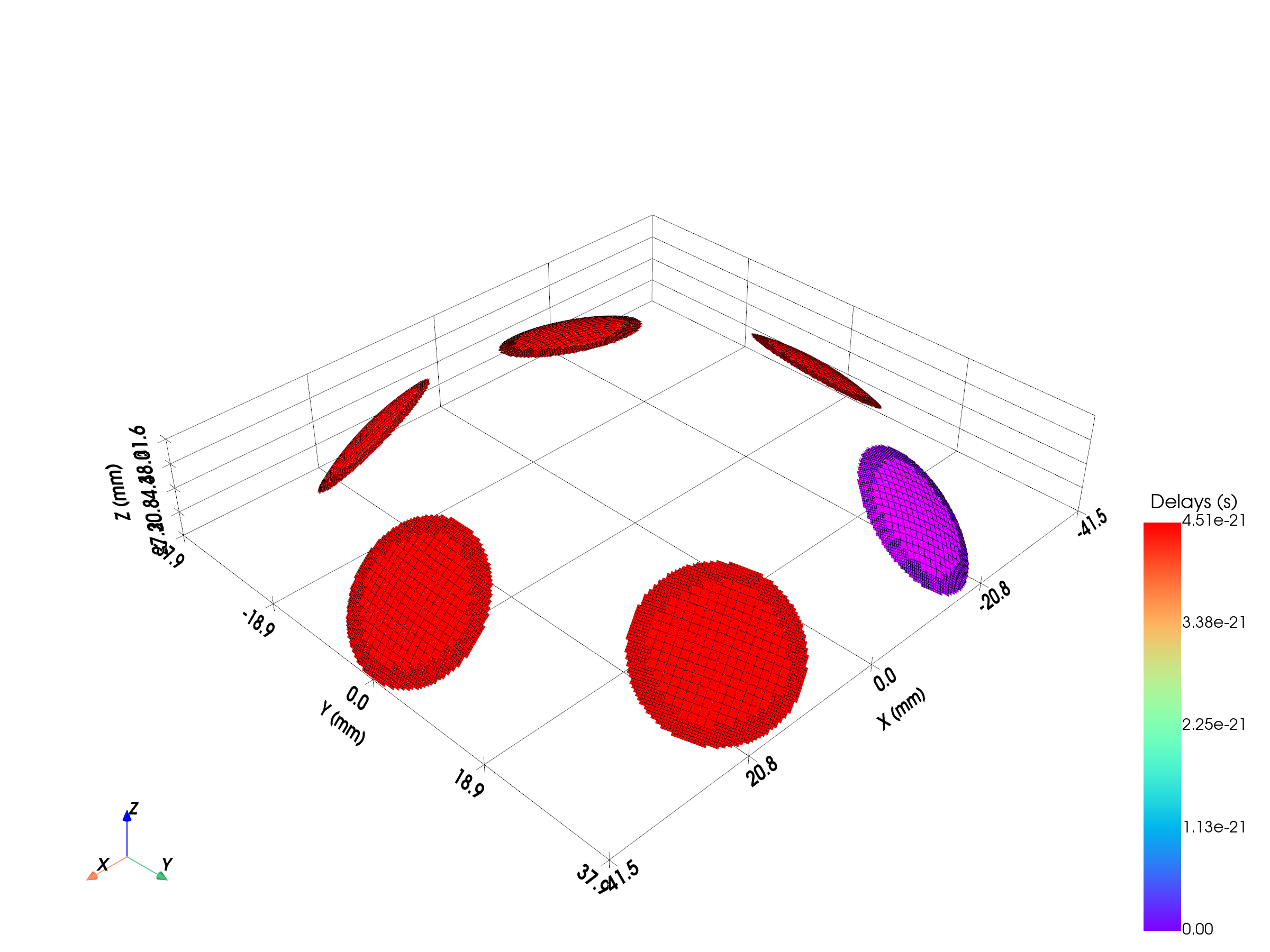
Arrays of independently driven elements — electronic steering and focusing via per-element delays and apodization. See the Transducers API and Example 3 — Multi-element 3-D.
 |
 |
 |
 |
Radiated pressure fields for these arrays live in the Emission guide.
At a glance
| Type | Layout | Steering |
|---|---|---|
LinearArrayTransducer |
1-D row along X | Lateral + depth (XZ) |
ConvexArrayTransducer |
Elements on convex arc | Wide-angle sector |
MatrixArrayTransducer |
2-D grid of elements | Full 3-D volumetric |
CustomTransducer |
Arbitrary positions | Per-element definition |
Basic usage
from esdiva.transducers import LinearArrayTransducer

tx = LinearArrayTransducer(
    n_elements=64,
    element_width_mm=0.25,
    element_height_mm=12.0,
    kerf_mm=0.05,
    no_sub_x=2,
    no_sub_y=4,
    frequency_Hz=5e6,
)

# Focus at (x=0, y=0, z=30 mm)
tx.compute_delays(focus_mm=[0, 0, 30])
tx.compute_apodization(focus_mm=[0, 0, 30], FoverD=2.0)
Delays and apodization can be recomputed for any focal point without recreating the transducer object.
Elevation lens
A linear array focuses electronically in the imaging plane but not in
elevation — the out-of-plane direction the image cannot show. Real probes add an
acoustic lens; eSDIva models it as geometry, curving each element's patches onto a
cylindrical arc when you pass elevation_focus_mm.
tx = LinearArrayTransducer(
    n_elements=64, element_width_mm=0.108, element_height_mm=4.0,
    kerf_mm=0.002, no_sub_x=1, no_sub_y=6,
    elevation_focus_mm=12.0,          # RADIUS of curvature (not the focal depth)
    frequency_Hz=12.5e6,
)
tx.elevation_focus_depth_mm     # 11.832 mm — where it actually focuses
tx.elevation_lens_sag           # +1.678e-4 m, signed
no_sub_y must be ≥ 2, or there are no patches to put on the curve.
elevation_focus_mm is a radius, like focus_mm on the circular transducers
It is the lens radius of curvature (the datasheet value, the Field II
xdc_focused_array Rfocus), not the depth the beam converges at. The lens
face sits at z = 0, so the arc's centre of curvature — the point every patch
is equidistant from, i.e. the true line focus — is one sagitta h²/(8R)
shallower than R (0.17 mm for a 4 mm aperture at R = 12 mm). Read the real
depth from elevation_focus_depth_mm. The mono-element focus_mm is the same
radius convention, but there the apex is the datum, so focus and radius coincide.
Sign — concave or convex. Positive curves the surface away from the medium
(concave, converging: an ordinary lens). Negative bulges it into the medium
(convex, diverging), spreading the elevation beam; its focus is virtual and
elevation_focus_depth_mm is then negative. A flat aperture returns inf.
Why it matters for measurements. The elevation beam at the focus is ≈ λ·z/H
wide — 0.36 mm for a 4 mm aperture at 12 mm, vs 1.7 mm unfocused at 22 mm. Any
quantity averaged over the resolution cell inherits that width: a Doppler velocity
is the power-weighted mean over the cell, so an unfocused elevation aperture reads
a vessel comparable to the beam as slower than it is. See
Flow Simulation.
The time origin already accounts for the curve
The curved surface sits off the z = 0 plane the beamformer measures depth
from, so reception subtracts the signed sag (once per aperture) from
coords["t0"]. Nothing to do at the call site — a point target lands at its
true depth for flat, concave and convex apertures alike. Emission needs no such
term: its t0 is a physical origin, not a beamforming reference.