Monochromatic Simulation
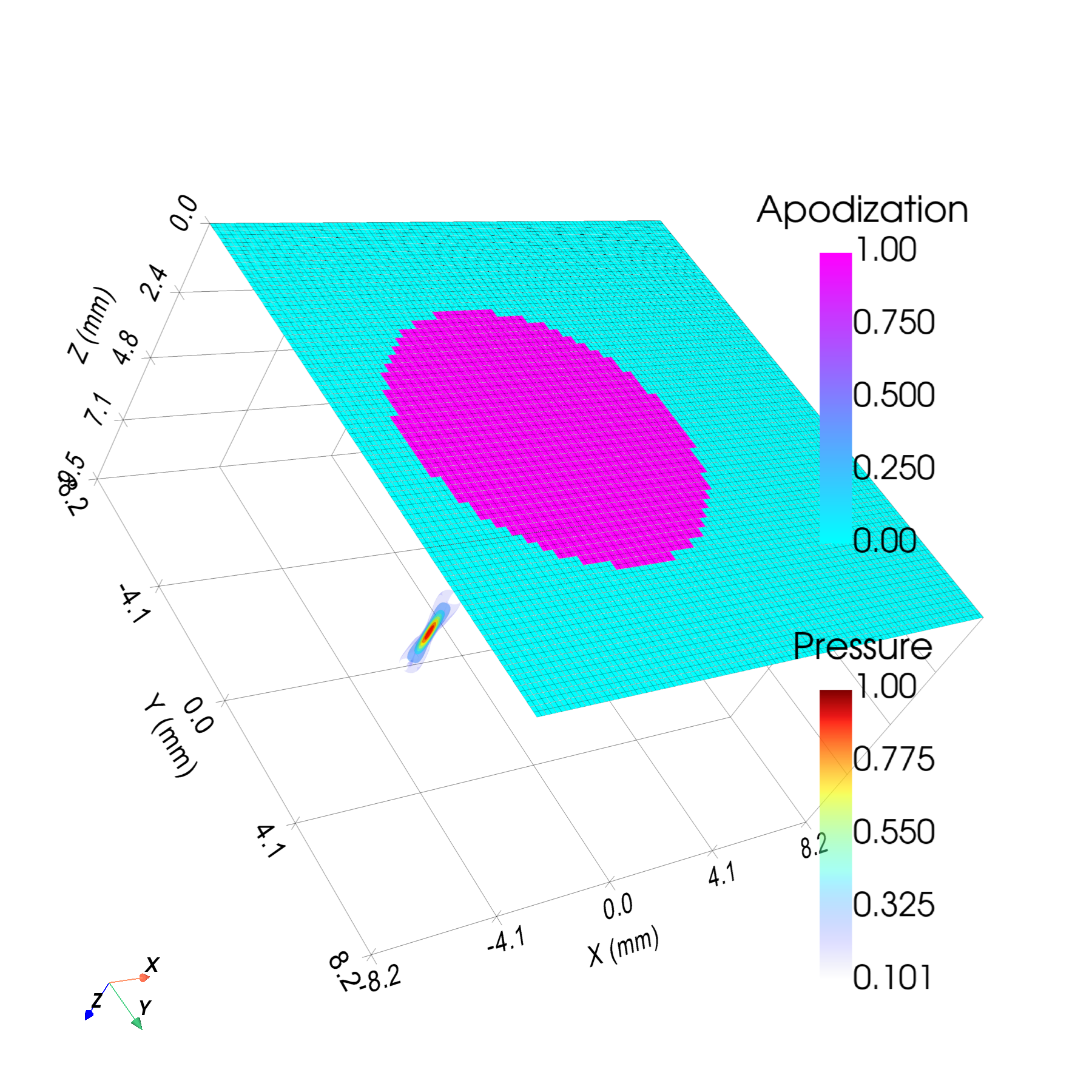
Monochromatic mode computes the steady-state pressure amplitude at exactly the
transducer centre frequency fc: |P(r, fc)| = ρ·ωc·|H(r, ωc)|, in pascals per 1 m/s
of surface velocity — a 3-D amplitude field p(x, y, z) with no time axis. By default
H(ωc) is evaluated in closed form at that single frequency (the spectral SIR), which
is the fastest route; attenuation, a soft baffle and a transfer_function apply at fc.
from esdiva.emission import Emission

sim = Emission(tx, monochromatic=True)
p, coords = sim(field_points)
# dict input : p.shape == (Nx, Ny, Nz), coords has "x", "y", "z"
# (N,3) input: p.shape == (N_points,), you reshape
When to use
- Beam-pattern analysis and −6 dB focal-spot characterisation.
- Comparing transducer geometries or subdivision settings.
- Fast field preview before a full transient run.