Example 23: A Diverging Multilens Element as a Rigid Cap
The multi-lens array of Haidour et al. (Nat. Commun. 2025, s41467-025-64911-z)
widens each element's beam with a diverging epoxy/silicone doublet lens. eSDIva is
linear and homogeneous — no refraction — so the lens can only be modelled as a
curved rigid cap whose surface sag reproduces the same aperture phase. This example
builds three candidate caps and compares each against the paper's measured directivity
(a Bessel bell crossing −6 dB at 33.17°), using
visualize_element:
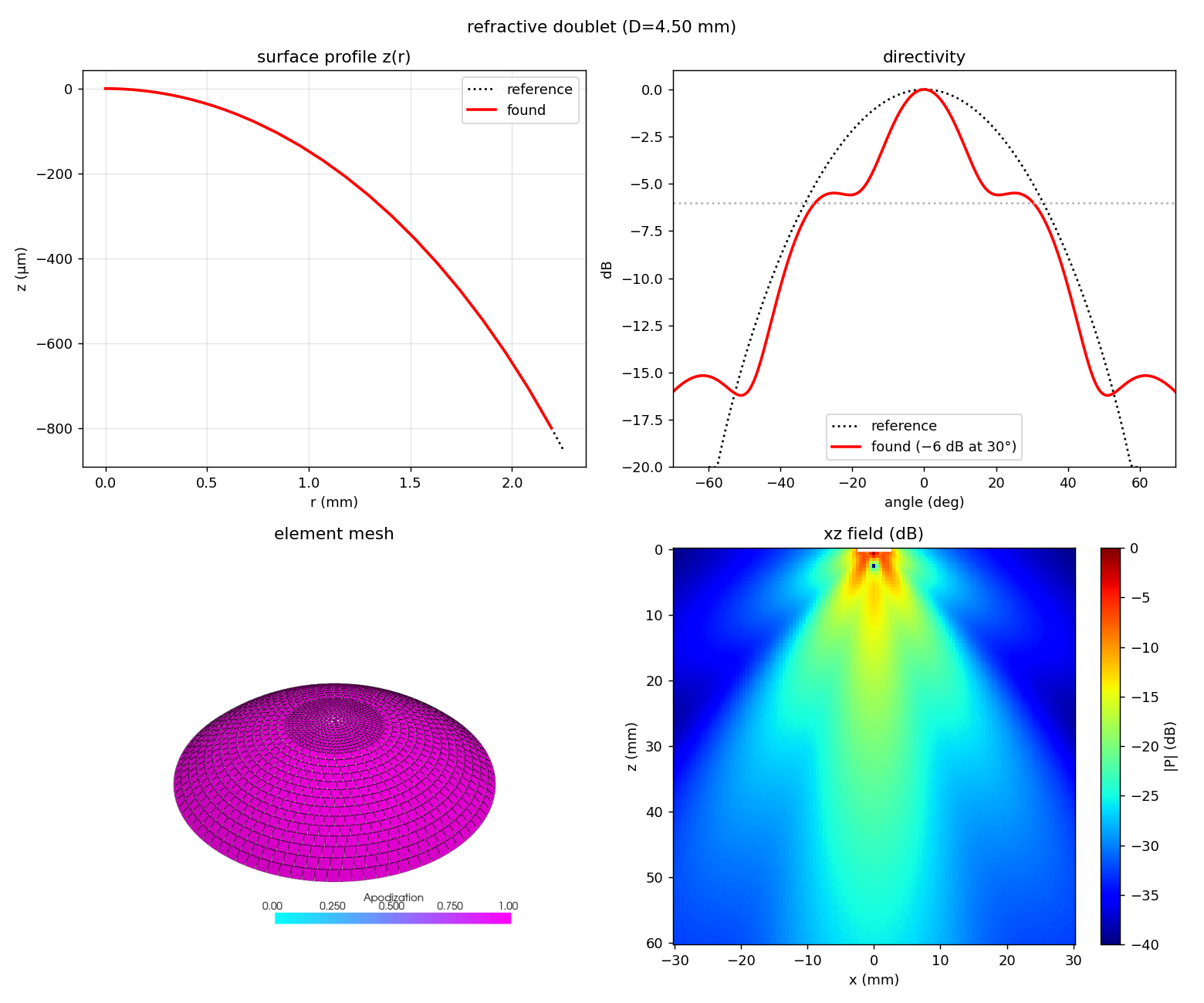
- refractive doublet — the paper's lens, collapsed through a refractive-index
(Snell) model to one effective cap
z(r) = −(n₂−n₁)·(R−√(R²−r²))(no optimization). - strictly convex cap — four even-power terms
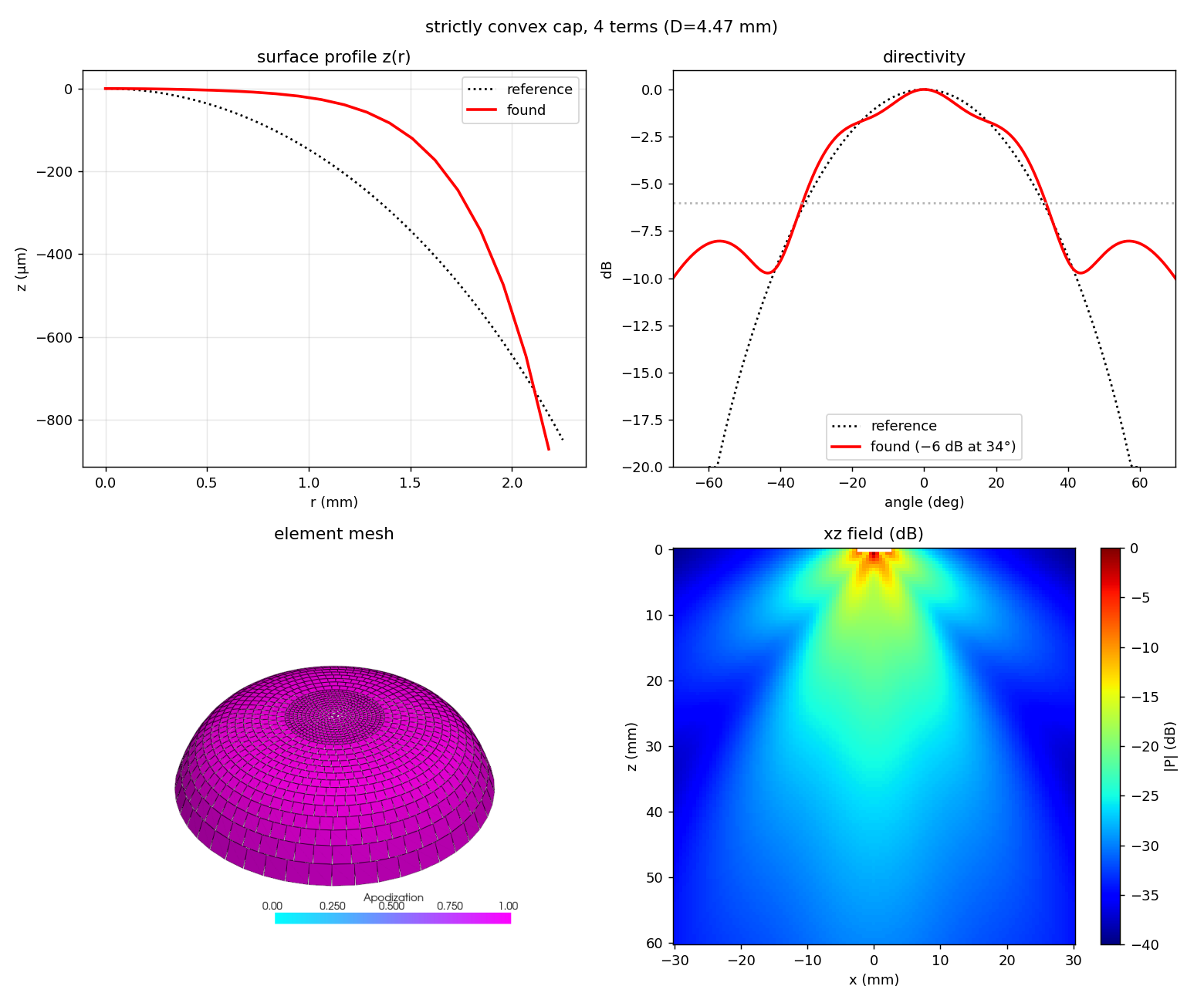
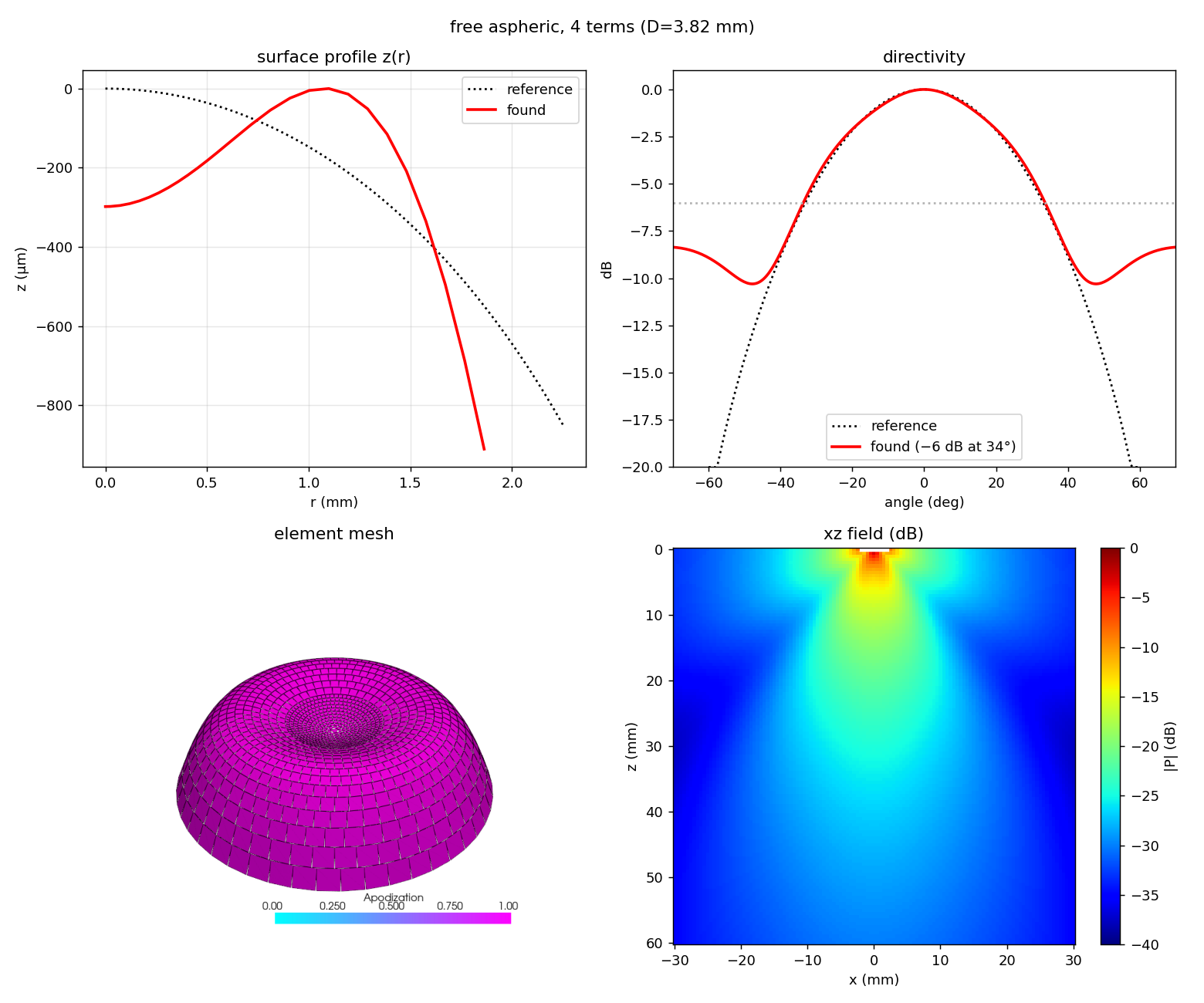
z(r) = −λ·Σ cₖ(r/R)^{2(k+1)}with non-negative coefficients, so the sag is monotone (apex at the centre, no dip) — the best purely convex rigid cap. - free aspheric — the same four terms but coefficients free to go negative, so a central dimple may form if it sharpens the agreement with the bell.
The parametric surface
An axisymmetric cap is even in r (symmetric about the axis, apex pinned to
z = 0), so only even powers appear — a Taylor expansion of z(r²):
import numpy as np

C0, FC = 1540.0, 1e6
LAMBDA_MM = C0 / FC * 1e3

def sag_of(coeffs, diameter_mm):
    r_ap, c = diameter_mm / 2 * 1e-3, np.asarray(coeffs, float)
    return lambda r: -LAMBDA_MM * 1e-3 * sum(
        c[k] * np.clip(np.asarray(r, float) / r_ap, 0, 1) ** (2 * (k + 1))
        for k in range(len(c))
    )
With non-negative coefficients every term increases outward, so z(r) decreases
monotonically — a convex diverging cap (apex at the centre). Allowing negative
coefficients lets a central dimple form (the free aspheric).
Fitting to the directivity
from scipy.optimize import minimize
from scipy.special import j1
from esdiva import Emission

# loss = mean-squared dB mismatch against the jinc bell inside the main lobe (±40°),
# with BOUNDED Nelder–Mead — the bounds keep D and the coeffs in range directly;
# clipping them inside the loss would flatten the objective past the edge and the
# simplex would drift onto that plateau. With a FREE diameter the loss vs D is
# multimodal, so the free-aspheric fit restarts from several diameters (multistart)
# and keeps the lowest-MSE result — a single start is not reproducible.
res = minimize(loss, x0, method="Nelder-Mead",
               bounds=[(3.0, 5.5)] + [coeff_bounds] * n_terms)
Well-posedness
Matching the main lobe alone is under-determined — a smooth convex cap and a central-dimple aspheric fit nearly the same bell, and with a free diameter Nelder–Mead can even walk to the diameter bound. Two guards keep the example well-posed: the coefficient sign (non-negative → convex; free → the dimple can appear) separates the two shapes, and multistart over the diameter (restart from several diameters, keep the lowest-MSE basin) makes each fit reproducible on an interior diameter. The two solutions are near-degenerate at ±40°, which is exactly why constraining the sign is what cleanly distinguishes "best convex cap" from "best free cap".
The three caps
Each is shown as a 2×2 panel: top row surface profile z(r) and directivity
(found solid-red vs reference dotted-black), bottom row the patch mesh (3-D render)
and the xz pressure plane. The refractive doublet reaches ~30°; both fitted caps reach ~34° but by different
shapes — the strictly convex cap (D≈4.5 mm) stays monotone, while the free aspheric
(D≈3.8 mm) develops a shallow central dimple that pulls the shoulder in a little tighter.
Neither fully removes the ±45° shoulder (spherical aberration) that the paper's real
multilens suppresses — a single rigid cap trades aperture phase for beam width, it cannot
reshape the lens's two-material refraction.
Watching the fit converge
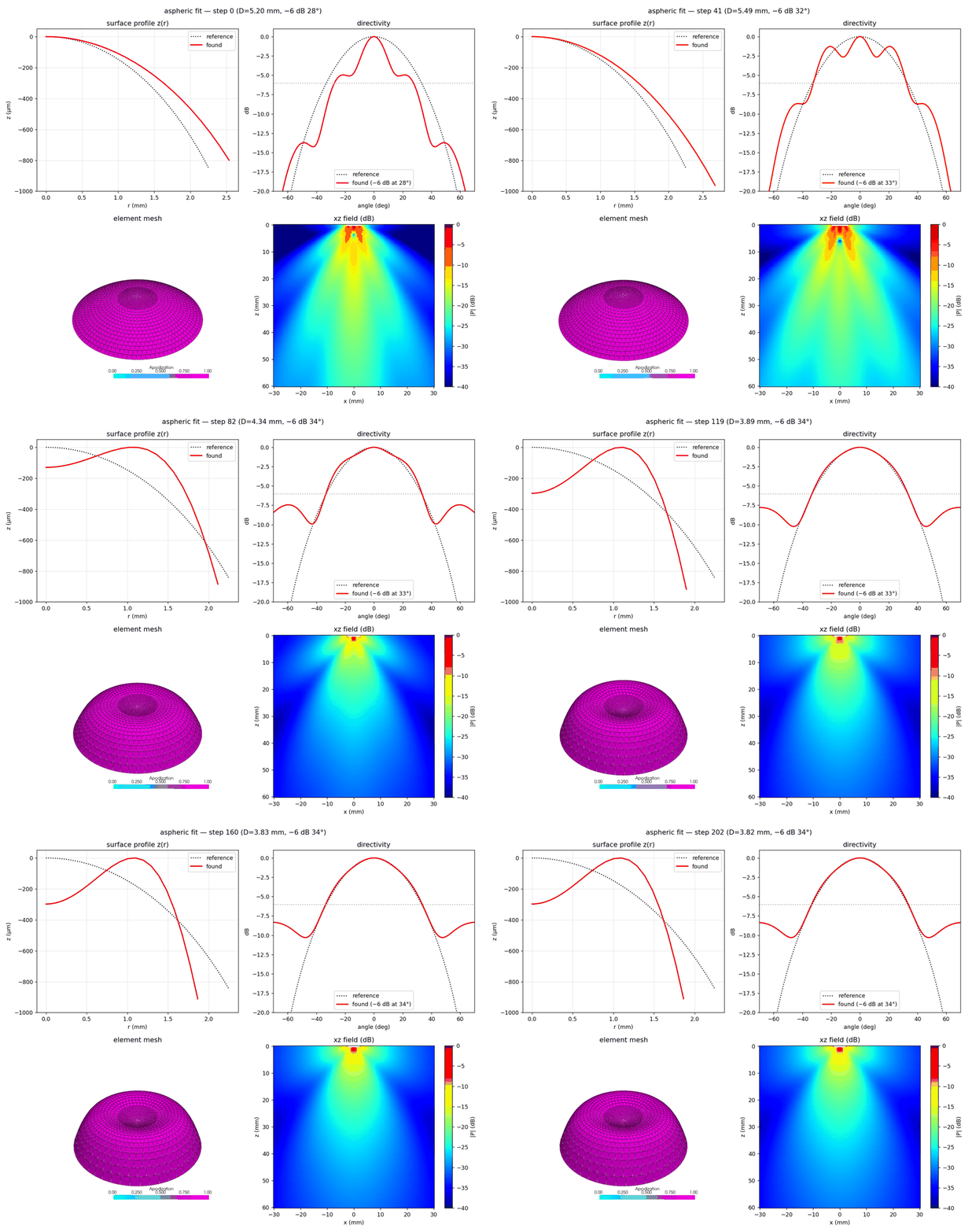
Each Nelder–Mead iterate of the free-aspheric fit is rendered with the same 2×2 panel, so the surface visibly deforms as the directivity closes on the bell — the central dimple forming and the shoulder pulling in over the run.