Attenuation
Power-law tissue attenuation is a causal frequency-domain transfer function multiplied onto the (lossless) SIR spectrum — absorption plus the Kramers-Kronig dispersion phase, so waveforms stay causal. The SIR kernels themselves are never modified, so attenuation works identically with the spectral and temporal kernels, in emission and in reception.
H_att(f, d) = exp(−α₀|f|^y d) · exp(−j·[dispersion phase, referenced at fc]·d)
| Parameter | Meaning |
|---|---|
alpha0 |
Attenuation coefficient in dB/(MHz^y·cm); None disables it |
freq_power |
Power-law exponent y (1.0 = linear-with-frequency; tissue 1.0–1.3) |
fast_attenuation |
Emission only: path from the transducer centre (True) or from each element (False, better near field) |
The dispersion is referenced at the centre frequency: the phase speed at fc equals
your c, and higher frequencies travel slightly faster (tissue-like positive
dispersion), continuously across y = 1.
Emission
The path d runs from the transducer centre to each field point (or from each element
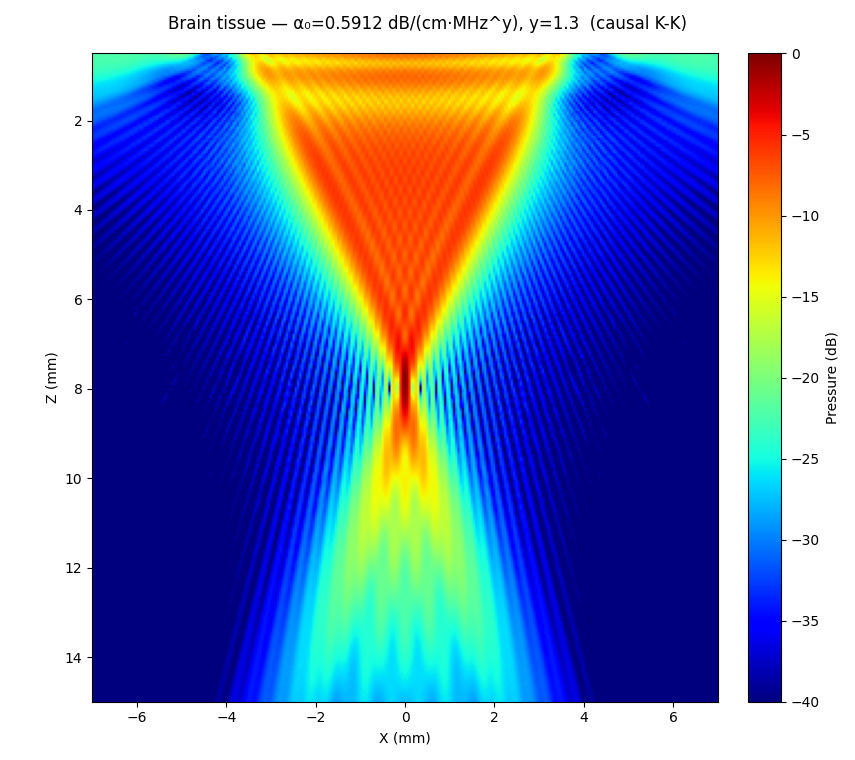
with fast_attenuation=False). Works in monochromatic mode (amplitude decay at fc) and
in transient mode (full spectral distortion, including the raw SIR).
from esdiva.emission import Emission

sim = Emission(tx, fs=200e6, excitation=pulse,
               alpha0=0.5,      # dB/(MHz^y · cm)
               freq_power=1.1)  # power-law exponent y
p, coords = sim(field_points)

sim_near = Emission(tx, fs=200e6, excitation=pulse, alpha0=0.5,
                    fast_attenuation=False)   # one path per element
Reception
The echo travels out and back, so d is the round trip transducer centre → scatterer →
each receive element's centre, with every reception method.
from esdiva.reception import Reception

sim = Reception(tx, rx, fs=200e6, excitation=pulse, alpha0=0.5, freq_power=1.1)
rf, coords = sim.pulse_echo_rf(scatterer_pos_mm, scatterer_amp)   # deeper echoes weaker
Deeper echoes lose amplitude and high frequencies faster than shallow ones, so the echo spectrum shifts down with depth — the reason real scanners apply time-gain compensation.