Example 20: Speckle Phantom — make_phantom() + Focused B-mode
Simulating tissue in pulse-echo means simulating speckle: many
sub-wavelength scatterers at random positions whose echoes interfere.
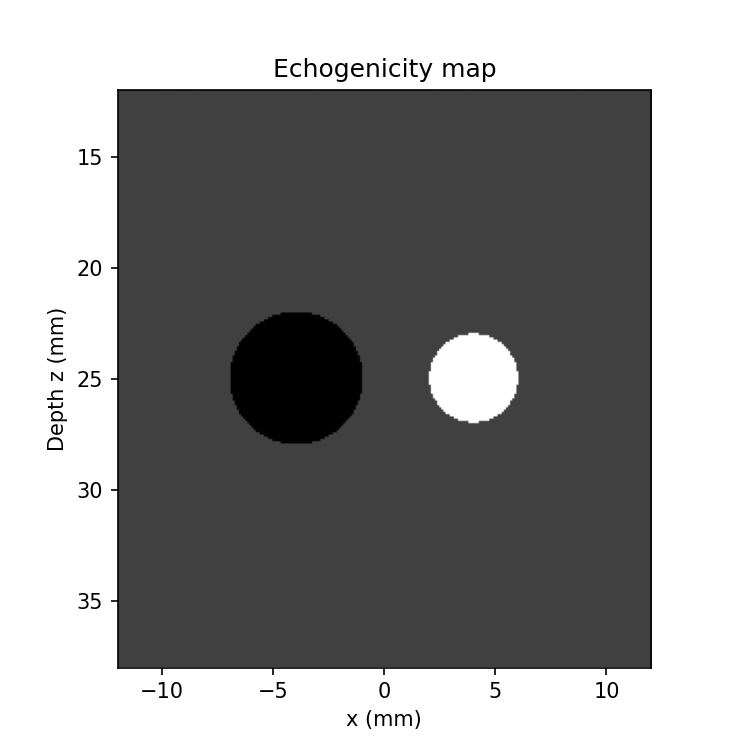
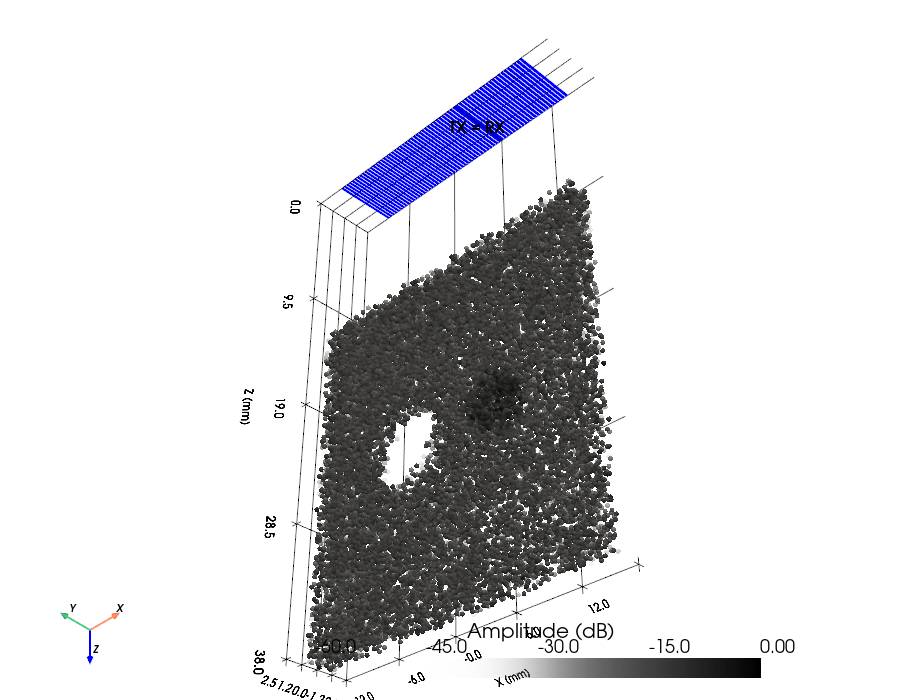
make_phantom builds such a cloud from an echogenicity image — here the
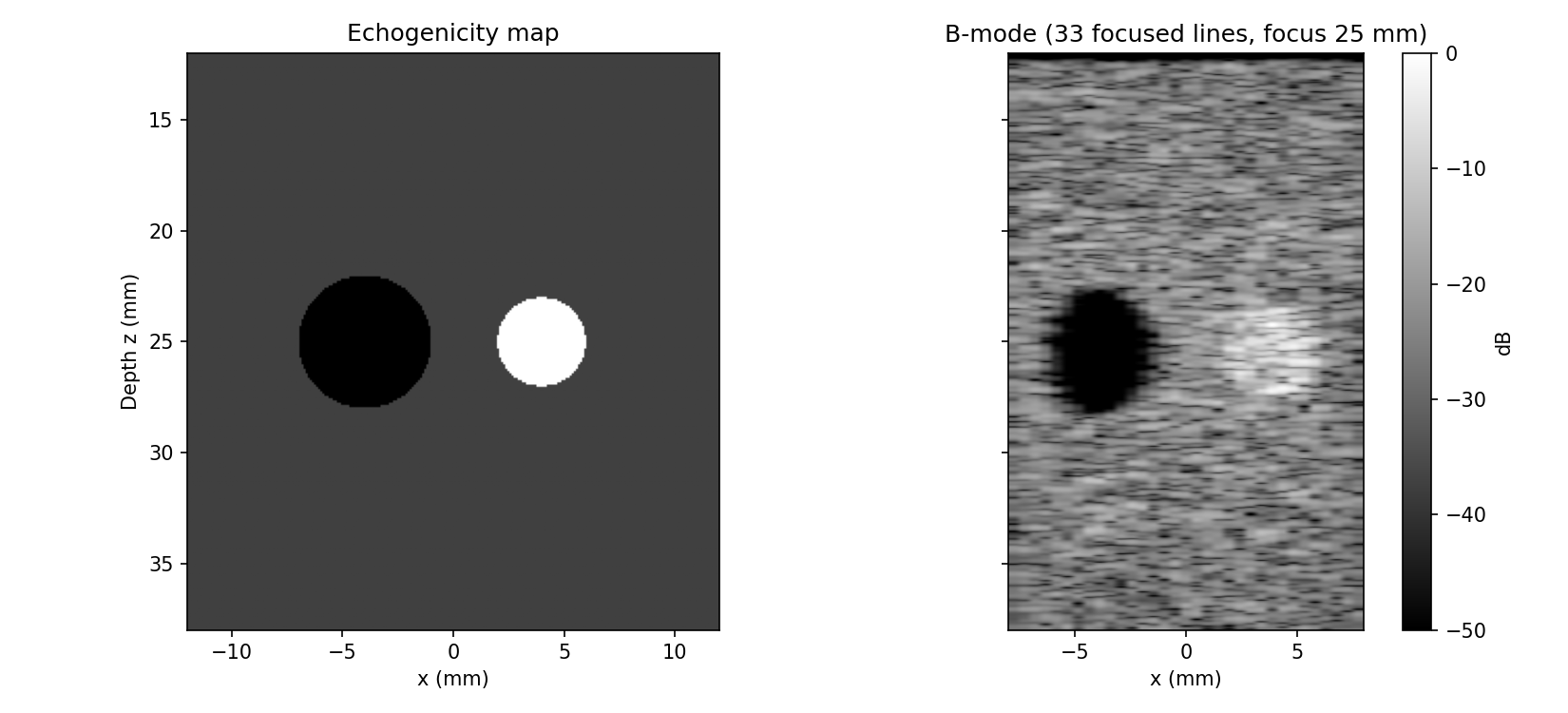
classic cyst phantom (anechoic cyst + hyperechoic lesion in a speckle
background), imaged line-by-line with scan_focusline.
What you will learn
make_phantom(extents_mm, n, echogenicity_map)— random positions +N(0,1)·map(r)amplitudes (a regular grid would return coherent lattice echoes, not speckle)- Scatterer density: fully developed speckle needs ≥ ~5–10 scatterers per
resolution cell
(λz/D)² · pulse/2 - Setting the piezo
impulse_response— without it the elements are ideally broadband and the aperture diffraction tails widen the PSF and fill the anechoic cyst with sidelobe clutter - Focused B-mode: one
scan_focuslinecall per lateral position, lines interpolated onto a common time axis
Output
Run it
Key code
from esdiva.reception import Reception
from esdiva.utilities import make_phantom

scat_pos, scat_amp = make_phantom(BOX, N_SCATTERERS, echogenicity_map=emap, seed=2026)

tx.impulse_response = excitation.copy()   # piezo band-pass, applied TX and RX
sim = Reception(tx, tx, c=C, fs=FS, excitation=excitation)
sim.show(scat_pos, scat_amp, TX_color="blue")   # preview before the long run

for xl in LINE_X:                          # one focused line per lateral position
    env, coords = sim.scan_focusline([xl, 0.0, FOCUS_Z], scat_pos, scat_amp,
                                     FoverD=2.0, apodization_type="hanning")